
Managed IT vs In-House: Which Works for a 10-Person Business?
Should a 10-person Florida business hire an in-house IT person or outsource to a managed IT provider? Real cost comparison, hidden trade-offs, and the honest answer.
If you run a 10-person business in Plant City, Tampa, or Lakeland and your tech needs are starting to outgrow “ask the guy at the office who’s good with computers,” you’re going to face a fork in the road: hire someone to handle IT in-house, or sign with a managed IT provider. I get this question from owners almost every week, and the math isn’t as obvious as people think.
Here’s how I’d actually think about it.
The salary math everyone runs first
A junior IT person in the Tampa Bay area: $45,000 to $55,000 per year. A mid-level IT generalist who can handle networking, Microsoft 365, and basic cybersecurity: $65,000 to $80,000. A true systems engineer who’s worth keeping around for years: $90,000+.
For a 10-person business, you’d usually look at the mid-level. Call it $70,000.
That’s $5,833 per month in salary alone.
Compare that to managed IT for a 10-person business: typically $750 to $1,500 per month all-in, including 24/7 monitoring, endpoint security, patching, backups, and same-day on-site response when something breaks.
On just the headline number, managed IT wins by roughly 4×. But that’s not the whole picture.
The real cost of hiring
The $70,000 salary is just the start. The actual loaded cost of an employee in Florida is typically 1.25× to 1.4× their salary once you factor in:
- Payroll taxes (FICA, FUTA, Florida reemployment tax): about 8% of wages
- Workers’ comp insurance: 2–4% of wages depending on classification
- Health benefits if you offer them, and most do for IT hires: $5,000 to $12,000 per year
- 401k match if you offer one: 3–5% of wages
- Equipment — laptop, monitors, phone, tools: $3,000 first year, about $1,500 per year ongoing
- PTO and sick days: 10 to 15 days per year of unpaid output
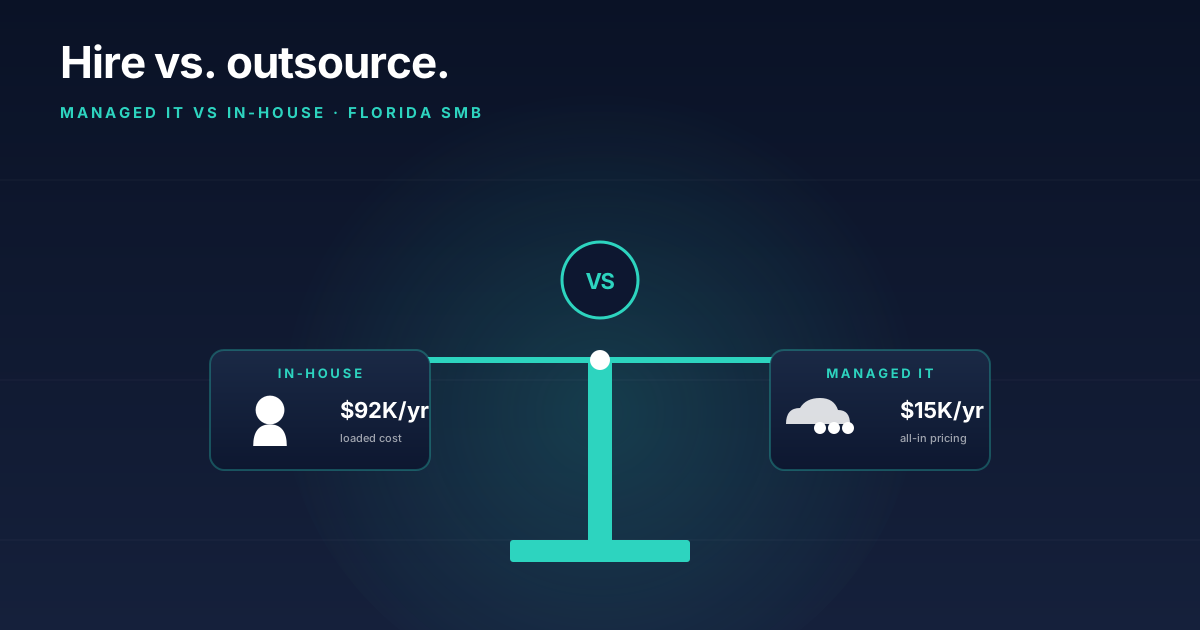
A $70,000 IT person actually costs your business closer to $92,000 to $98,000 per year, or $7,700 to $8,200 per month.
Now add the harder-to-quantify costs:
- Downtime when they’re out. Vacation week, sick day, training day — your IT support is just gone. When the firewall blows on the day they’re at the dentist, you’re calling break-fix at $200/hour anyway.
- They can’t be expert at everything. A single hire is good at maybe 60% of what you need. Networking specialist? Probably not also a cybersecurity expert. Microsoft 365 wizard? Probably not also great with phone systems. Most 10-person shops need 4–5 specialties at once.
- Recruiting cost. An average tech hire takes 2–3 months to fill. If you go through a recruiter, that’s 15–20% of first-year salary. Call it $10,000 to $14,000 just to find them.
- Turnover. Average IT employee tenure at a small business is 18–30 months. Then you do it all again.
The real cost of managed IT
The honest version: managed IT isn’t free either, and the pricing varies more than people realize.
Per-user-per-month plans. The most common model. $75 to $150 per user per month covering monitoring, patching, helpdesk, security, backups. For 10 users, that’s $750 to $1,500 per month, or $9,000 to $18,000 per year.
Per-device plans. $30 to $80 per device per month. If you have 10 employees but they each have a laptop, a desktop, and a phone, you’re at 30 devices, so $900 to $2,400 per month. Sometimes more cost-effective for businesses with fewer devices per employee.
Hybrid plans. Flat monthly fee + hourly for project work. Common for businesses that don’t need daily support but want a relationship in place when things go sideways.
What’s NOT usually included: new hardware (you still buy your own laptops, firewalls, cameras), software licenses (Microsoft 365 seats, third-party SaaS), and major projects like office moves or full network rebuilds — those get quoted separately.
For a 10-person Florida business with standard needs, expect $1,000 to $1,500 per month all-in.
What you actually get differently
Cost aside, the structural difference matters more than people realize.
One hire equals one perspective. They’ll be solid in their specialty and weak elsewhere. They’ll have biases — the vendor they used at their last job, the platform they’re most comfortable with, the way they like to do things.
Managed IT equals a team of specialists behind one face. When I take on a client, they’re getting access to a network engineer, a cybersecurity practitioner, a Microsoft 365 admin, a backup architect, and a hardware procurement person. Most of those is me — but the value is that I’ve spent the last 15 years specializing across all of them so I’m not learning on your dime.
Response time. A single hire can only be in one place. A managed IT relationship has redundancy — when something breaks at 7pm, the right person is available. When two things break at once, both get triaged.
Tooling and process. A managed IT provider has invested in PSA and RMM platforms, monitoring stacks, ticketing systems, documentation tools. A new hire shows up with their laptop and a friendly demeanor and has to build all of that from scratch — usually on your dime.
When in-house actually makes sense
A few scenarios where I tell prospects to hire instead of outsource:
- You have 30+ employees and growing fast. At that size, a full-time IT person plus a managed IT relationship for specialty work makes more sense than relying on one or the other alone.
- You have unique software or workflows. Custom ERP, manufacturing systems, line-of-business apps that need constant tuning. Worth having someone in-house who lives in that software daily.
- You need someone physically present every day. Some businesses — manufacturing, large warehouses, retail with dozens of POS terminals — genuinely have enough daily tech work that someone on-site is justified.
- Compliance requirements. HIPAA, PCI-DSS, NIST 800-171 contracts. Often easier with a dedicated person who owns the compliance posture full-time.
For a typical 10-person Plant City professional services firm? Probably not.
When managed IT is the answer
The default for most small businesses, honestly:
- 5 to 25 employees
- Standard tech: Microsoft 365 or Google Workspace, line-of-business apps from major vendors, normal office network
- IT problems happen weekly but not daily
- Owner wants to think about tech as little as possible and trust that it’s handled
This is roughly 80% of the small businesses I talk to.
The hybrid model
For businesses in the 25 to 50 employee range, the right answer is often both.
- One in-house IT person, or an office manager who can handle Tier 1 work: password resets, printer issues, new-hire onboarding.
- Managed IT relationship for Tier 2 and 3: cybersecurity, networking, backups, escalation, after-hours coverage, project work.
This gives you the in-the-room responsiveness of an employee with the depth and redundancy of a team. Costs roughly $90,000 to $110,000 per year combined, which sounds high but is usually less than 2 mid-level IT employees AND gets you broader coverage.
What I’d actually do if I were you
If you’re a Plant City or Tampa Bay business with 5 to 25 employees and you’re spending more than 4 hours a month on IT issues:
- Get one or two managed IT quotes including mine. Compare what’s actually included, not just the headline price.
- Math out the loaded cost of an in-house hire with the real numbers above. Compare to 2 to 3 years of managed IT.
- Look at your specific risks. How much downtime would actually cost you (I wrote about the real cost of an hour of downtime here), whether you have compliance constraints, whether your software is standard or specialized.
If managed IT looks like the right fit, book a free 30-minute consultation and I’ll walk through what’s actually in our plans for businesses your size. If in-house looks right, I’ll tell you that honestly — I’d rather refer you out than sell you a service you don’t need. See what’s included in our managed IT service for the version most small businesses end up with.
The wrong answer for most 10-person businesses is the third option: neither one, just calling break-fix every time something breaks. That’s the most expensive of all three. Pick a path.
Tags: #managed it#in-house#small business#florida#msp#tampa bay
Need help with this in your business?
Bearded Bytes provides on-site IT support, cybersecurity, and managed services across Plant City and the Tampa Bay area. Book a free consultation.
Talk to Brendan →