Cyber Insurance Requirements Every Florida Small Business Must Meet
Cyber insurance applications now demand MFA, EDR, and tested backups. Here's what Florida small businesses need in place to qualify and avoid a denied claim.
Here’s the uncomfortable truth: I’ve had two clients this year find out, mid-renewal, that their cyber insurance policy wasn’t going to pay out on a claim they hadn’t even filed yet — because the security controls they’d checked “yes” to on the application weren’t actually in place. One of them had told his broker he had multi-factor authentication rolled out “everywhere.” It was turned on for exactly one account: his own.
If you run a small business in Tampa, Plant City, or anywhere in Central Florida and you carry — or are shopping for — a cyber liability policy, this matters more than it did even two years ago. Insurers have gotten a lot more specific about what they’ll actually cover, and a lot less forgiving about applications that don’t match reality. Let me walk you through what’s changed, what insurers are actually asking for now, and what I’d fix before your next renewal.
Why cyber insurance got so much harder to qualify for
A few years ago, a cyber policy application was a page of yes/no questions and a check. Insurers paid out on ransomware claims constantly, and constantly means underwriters started losing money on the category. So they did what every insurance market does when claims outpace premiums: they got stricter about who qualifies, and they started actually verifying the answers instead of taking them at face value.
What changed in practice is that insurers now treat certain controls as non-negotiable baseline requirements, not nice-to-haves that improve your rate. If you don’t have them, you either don’t get a policy, you get one with a coverage exclusion tied to the missing control, or worse — you get the policy, suffer an incident, and find out during the claims investigation that the missing control voids the payout. That last scenario is the one that actually ends businesses, because you’re out the ransom, the downtime, and the recovery cost, with nothing behind you.
Florida makes this sharper than it might be elsewhere. We’ve got a dense small business population in professional services, healthcare-adjacent practices, and hospitality — all sectors that ransomware groups target because they know the businesses can’t afford extended downtime and often pay quickly. Insurers price Florida policies with that in mind, and they underwrite Florida applications more carefully as a result.
What insurers are actually requiring now
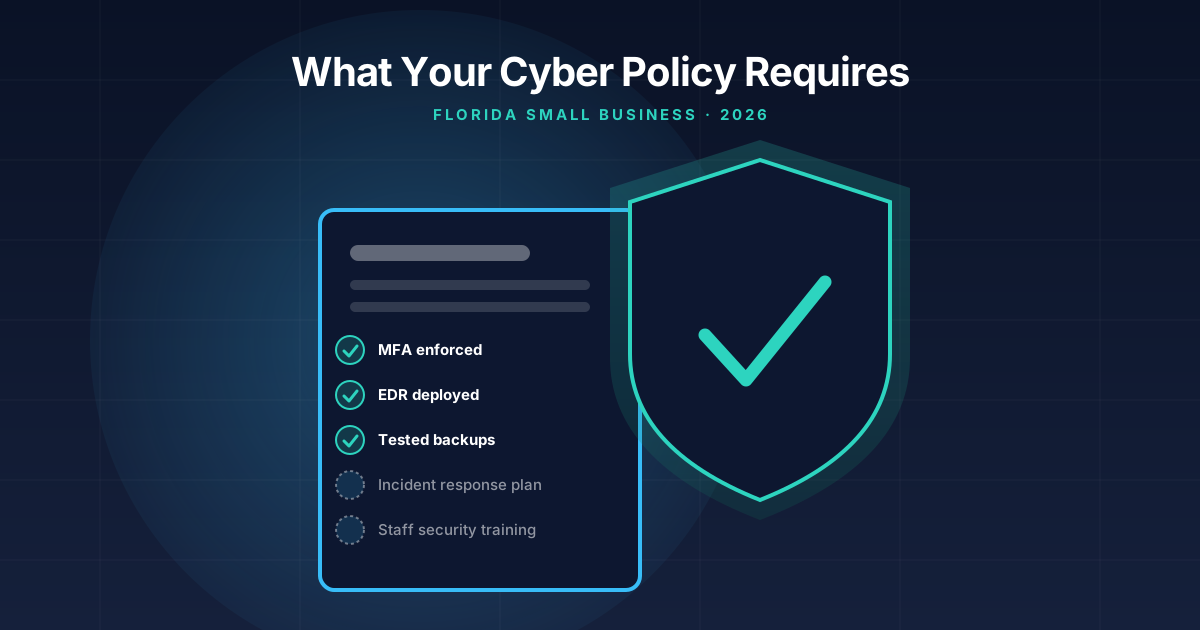
The specific list varies by carrier, but after reviewing more renewal applications with clients than I’d like to count, the same core set of controls shows up almost every time:
Multi-factor authentication, everywhere — not just email. This is the single biggest gap I find. Clients have MFA on their Microsoft 365 login and assume that satisfies the requirement. Insurers are asking about MFA on remote access (VPN, RDP), on admin accounts, and increasingly on any cloud application that touches sensitive data. “We have MFA” and “we have MFA on every login that matters” are very different answers on paper and very different outcomes during a claims review.
Endpoint detection and response (EDR), not just antivirus. Traditional antivirus catches known malware signatures. EDR watches for suspicious behavior — a process trying to encrypt hundreds of files in a row, for instance — and can shut it down before it spreads. A lot of small businesses still have a consumer-grade antivirus product running and check “yes” to the endpoint protection question, which is a meaningfully different thing than what the underwriter is picturing.
Backups that are tested, offsite, and segregated from your network. I wrote a while back about why cloud vs. local backup isn’t really an either/or decision — insurers care about exactly the same distinction. A backup that ransomware can reach and encrypt right alongside your primary files doesn’t count as a real backup in their eyes, and increasingly the application asks directly whether backups are immutable or air-gapped.
Security awareness training for employees. Phishing is still the number one way ransomware gets a foothold, and insurers know it. Some carriers now want documentation that your team has gone through training in the last 12 months, not just a policy stating employees “should be careful.”
A written incident response plan. Not a formal 40-page document necessarily, but something that says: here’s who we call first, here’s who has authority to make decisions, here’s how we notify affected parties if required. Florida’s breach notification law has specific timelines you’re on the hook for regardless of what your insurance covers — I covered what those requirements actually are in an earlier post, and insurers are increasingly asking whether you have a plan that accounts for them.
The application questionnaire trap
Here’s where I see business owners get hurt without meaning to. The renewal application lands in an email, it’s long, it’s full of security terminology that doesn’t mean much to someone running a plumbing company or a dental practice, and the instinct is to answer quickly and optimistically. “Do you have MFA enabled?” Yes, mostly. “Do you have an EDR solution deployed?” We’ve got antivirus, close enough. “Are backups tested regularly?” We have backups.
None of those are lies exactly. They’re optimistic rounding. But insurance contracts don’t grade on a curve, and a material misrepresentation on an application is one of the most common reasons carriers deny claims after the fact. If an incident happens and the forensic investigation the insurer runs turns up that MFA wasn’t actually enforced on the account that got compromised, or the “tested” backup hadn’t been restored from in over a year, you can end up fighting your own insurer instead of collecting on the policy you paid for.
The fix isn’t to lie less — it’s to close the actual gap before you answer the question. If the honest answer to a control question is “not yet,” that’s worth knowing before renewal, not after a breach.
What I’d actually do before your next renewal
If you’re due for a cyber policy renewal in the next few months, here’s the order I’d work through it in:
- Get the actual application questions in front of you now, not the week the policy expires. Read each control requirement literally, the way an underwriter would, not the way you’d like it to be true.
- Audit MFA coverage account by account. Admin accounts, remote access, financial software, anything cloud-based — not just the email inbox.
- Confirm what’s actually running on your endpoints. If it’s consumer antivirus rather than a managed EDR platform, that’s a gap worth closing before you’re asked to attest otherwise.
- Get a real answer on your backups. Not “the backup job ran last night” — an actual test restore, on record, with a date attached.
- Put a one-page incident response plan in writing. Who calls whom, in what order, and what Florida’s notification clock requires of you.
None of this is about gaming an insurance form. It’s that the controls insurers are asking about are, not coincidentally, the same controls that actually prevent a ransomware event from becoming a business-ending one. The application is a decent audit checklist even if you never file a claim.
Where this fits with what we do
This is exactly the kind of gap analysis I run through with clients during a free consultation — going line by line through what a cyber policy or renewal application is actually asking for, and being honest about where the answer is “not yet.” Closing those gaps is core to our managed IT and cybersecurity services: MFA rollout, EDR deployment, tested backup strategy, and the documentation to back it all up when an underwriter or a claims adjuster comes asking.
If you’ve got a renewal coming up and you’re not sure whether your “yes” answers would hold up under a real review, that’s worth a conversation before you sign, not after you file a claim.
Tags: #cyber insurance#mfa#edr#compliance#small business#florida
Need help with this in your business?
Bearded Bytes provides on-site IT support, cybersecurity, and managed services across Plant City and the Tampa Bay area. Book a free consultation.
Talk to Brendan →